import os
from omegaconf import OmegaConf
import pandas as pd
import numpy as np
import rasterio as rio
import matplotlib.pyplot as plt
import geopandas as gpd
import seaborn as sns
from tqdm.notebook import tqdm
#
from IPython.display import IFrame, Image
#
from src import utils as ut
from src import geo
from src import data
from src import plot
%matplotlib widget
%load_ext autoreload
%autoreload 2In [1]:
Main task:
starting from a peak in an Italian region, create a visibility network of mountain peaks and identify a series of routes with the best panoramic views Digital elevation model (DEM) of the whole Italian territory https://tinitaly.pi.ingv.it/
Environment Setup
set random seeds and create initial directories if not existing
In [2]:
conf = OmegaConf.load("config.yaml")
ut.set_environment(conf.env.seed)
os.makedirs(conf.env.figures.path, exist_ok=True)
Data retrieval
download required data
| Name | Author | CRS | EPSG | License |
|---|---|---|---|---|
| TINITALY 1.1 Digital Elevation Model |
INGV Tarquini et al. |
WGS84 UTM zone 32N |
32062 | CC BY 4.0 |
| ISTAT Italian boundaries |
ISTAT | WGS84 UTM zone 32N |
32062 | CC BY 3.0 |
| SAT Trentino mountain trails |
SAT | ETRS89 UTM zone 32N | 25832 | ODbL |
references:
- Tarquini, S., Isola, I., Favalli, M., & Battistini, A. (2007). TINITALY, a digital elevation model of Italy with a 10 meters cell size (Version 1.1). Istituto Nazionale Di Geofisica e Vulcanologia (INGV), 10. https://doi.org/10.13127/tinitaly/1.1
- Tarquini, S., Isola, I., Favalli, M., Mazzarini, F., Bisson, M., Pareschi, M. T., & Boschi, E. (2007). TINITALY/01: A new triangular irregular network of Italy. Annals of Geophysics. https://doi.org/10.4401/ag-4424
- Istituto Nazionale di Statistica. (2023). Confini delle unità amministrative a fini statistici al 1° gennaio 2023. https://www.istat.it/it/archivio/222527
- Società degli Alpinisti Tridentini (SAT). (2023). Sentieri dell’intera rete SAT. https://sentieri.sat.tn.it/static/download-sentieri.html
In [3]:
if conf.dem.download:
    data.download_dem(
        url_root     = conf.dem.url.root,
        url_download = conf.dem.url.download,
        outpath      = conf.dem.path,
        tiles        = conf.dem.tiles)
#
if conf.boundaries.download:
    data.download_zip(
        url     = conf.boundaries.url,
        outpath = conf.boundaries.path.root)
#
if conf.routes.download:
    data.download_zip(
        url     = conf.routes.url,
        outpath = conf.routes.path)
Data Exploration
DEM Raster
Check rasters metadata for validation
In [4]:
In [4]:
| CRS | Shape | Height [km] | Width [km] | |
|---|---|---|---|---|
| Tile | ||||
| w51560 | EPSG:32632 | (5005, 5010) | 50.05 | 50.1 |
| w51060 | EPSG:32632 | (5010, 5010) | 50.10 | 50.1 |
| w50560 | EPSG:32632 | (5010, 5010) | 50.10 | 50.1 |
| w51565 | EPSG:32632 | (5010, 5010) | 50.10 | 50.1 |
| w51065 | EPSG:32632 | (5010, 5010) | 50.10 | 50.1 |
| w50565 | EPSG:32632 | (5010, 5010) | 50.10 | 50.1 |
| w51570 | EPSG:32632 | (5010, 5010) | 50.10 | 50.1 |
| w51070 | EPSG:32632 | (5010, 5010) | 50.10 | 50.1 |
| w50570 | EPSG:32632 | (5010, 5010) | 50.10 | 50.1 |
some tiles have different shapes as they are at the boundaries of Italy.
Italian Boundaries
In [5]:
reg = gpd.read_file(os.path.join(conf.boundaries.path.root, conf.boundaries.path.shp))In [6]:
Code
reg = gpd.read_file(os.path.join(conf.boundaries.path.root, conf.boundaries.path.shp))
print("COLUMNS: " + str(reg.columns))
print("CRS: " + str(reg.crs))
COLUMNS: Index(['COD_RIP', 'COD_REG', 'COD_PROV', 'COD_CM', 'COD_UTS', 'DEN_PROV',
'DEN_CM', 'DEN_UTS', 'SIGLA', 'TIPO_UTS', 'Shape_Area', 'geometry'],
dtype='object')
CRS: EPSG:32632columns are described here: https://www.istat.it/it/files//2018/10/Descrizione-dei-dati-geografici-2020-03-19.pdf
Filter out for the desired region of interest by looking at the field DEN_UTS (or DEN_PROV) for the Provincia Autonoma di Trento. Switch it to COD_REG if interested in a region.
In [7]:
Code
reg = reg.loc[reg.DEN_UTS.str.lower().str.contains(str(conf.boundaries.region).lower())]
reg| COD_RIP | COD_REG | COD_PROV | COD_CM | COD_UTS | DEN_PROV | DEN_CM | DEN_UTS | SIGLA | TIPO_UTS | Shape_Area | geometry | |
|---|---|---|---|---|---|---|---|---|---|---|---|---|
| 21 | 2 | 4 | 22 | 0 | 22 | Trento | - | Trento | TN | Provincia autonoma | 6.208170e+09 | POLYGON ((716676.337 5153931.623, 716029.354 5... |
Routes
In [8]:
Code
routes = gpd.read_file(conf.routes.path)
print("COLUMNS: " + str(routes.columns))
print("CRS: " + str(routes.crs))
COLUMNS: Index(['numero', 'competenza', 'denominaz', 'difficolta', 'loc_inizio',
'loc_fine', 'quota_iniz', 'quota_fine', 'quota_min', 'quota_max',
'lun_planim', 'lun_inclin', 't_andata', 't_ritorno', 'gr_mont',
'comuni_toc', 'geometry'],
dtype='object')
CRS: EPSG:25832This needs to be converted to the WGS84 - UTM 32N
Check the amount of errors between the nominal planimetric length of the routes (lun_planim), and the one computed by geopandas.
In [9]:
routes['error'] = routes.geometry.length-routes.lun_planimExplore the distributions of the routes metadata
In [10]:
px = 1/plt.rcParams['figure.dpi']
fig, ax = plt.subplots(figsize=(conf.env.figures.width*px,conf.env.figures.width*px*0.5))
routes.plot(kind='box', subplots=True, sharey=False, widths=0.5, ax=ax,
            title='Routes information distribution')
plt.subplots_adjust(wspace=1.3)
fpath = os.path.join(conf.env.figures.path, "fig-routes-dst.png")
plt.savefig(fpath)
plt.close()
Image(fpath, width=conf.env.figures.width, height=conf.env.figures.width*0.5)
/home/davide/.local/share/virtualenvs/unitn_geospatial-7KxAb5oA/lib/python3.11/site-packages/geopandas/plotting.py:982: UserWarning: To output multiple subplots, the figure containing the passed axes is being cleared.
return PlotAccessor(data)(kind=kind, **kwargs)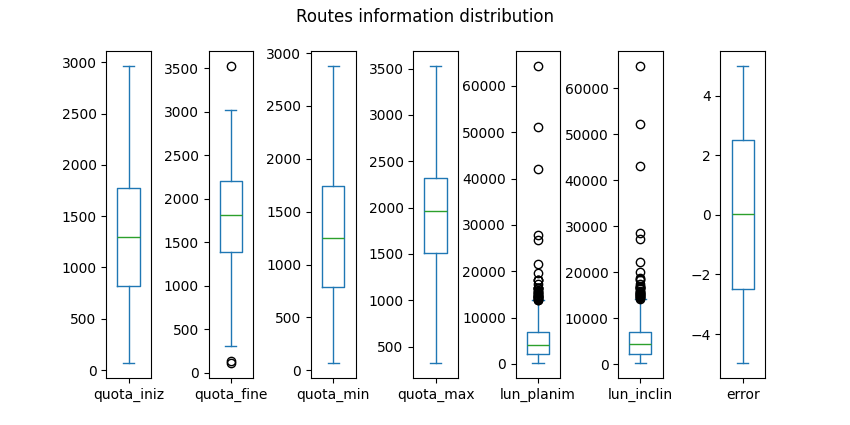
Visualize if some routes are out of the regional bounds
In [11]:
raster = data.merge_rasters(conf.dem.path, conf.dem.tiles, resolution=conf.dem.downsampling)
routes = routes.to_crs(raster.rio.crs)
routes = data.add_raster_coords(routes, raster.rio.transform)
reg = data.add_raster_coords(reg, raster.rio.transform, area=True)
fig = plot.plot_routes_bounds(np.array(raster[0]), reg, routes)
fpath = os.path.join(conf.env.figures.path, "fig-routes-out.html")
fig.write_html(fpath)
IFrame(src=fpath, width=conf.env.figures.width, height=conf.env.figures.width*0.84)Data Preprocessing
In [12]:
if conf.env.prepare_data:
    # Merge tiles into unique raster and downsample
    raster = data.merge_rasters(conf.dem.path, conf.dem.tiles, resolution=conf.dem.downsampling)
    # Get regional (provincial) boundaries
    reg = gpd.read_file(os.path.join(conf.boundaries.path.root, conf.boundaries.path.shp))
    reg = reg.to_crs(raster.rio.crs)
    reg = reg.loc[reg.DEN_UTS.str.lower().str.contains(str(conf.boundaries.region).lower())]
    # Clip raster to region boundaries
    # raster = raster.rio.clip(reg.geometry.values, reg.crs)
    # Save raster
    raster.rio.to_raster(conf.dem.output)
    # Routes preparation
    routes = gpd.read_file(conf.routes.path)
    routes = routes.to_crs(raster.rio.crs)
    # Extract rows and columns coordinates of each point in the line
    routes['coords'] = routes['geometry'].apply(lambda x: x.coords.xy)
    routes['row'], routes['col'] = zip(*routes['coords'].apply(
        lambda x: rio.transform.rowcol(raster.rio.transform(), x[0], x[1])))
    routes = routes.drop(['coords'], axis=1)
    # Do the same for the region
    reg['coords'] = reg['geometry'].apply(lambda x: x.boundary.coords.xy)
    reg['row'], reg['col'] = zip(*reg['coords'].apply(
        lambda x: rio.transform.rowcol(raster.rio.transform(), x[0], x[1])))
    reg = reg.drop(['coords'], axis=1)
    # Take routes only inside region of interest
    routes = routes[routes.within(reg.geometry.values[0])]
    routes.to_parquet(conf.routes.output)
    reg.to_parquet(conf.boundaries.output)
NOTE: routes modified dataset must be released under ODbL!
In [13]:
raster = rio.open(conf.dem.output)
dem = raster.read(1)
transform = raster.transform
crs = raster.crs
routes = gpd.read_parquet(conf.routes.output)
reg = gpd.read_parquet(conf.boundaries.output)
In [14]:
# #| label: fig-routes-proc
# #| fig-cap: "Exploratory analysis of in- and out-of-bounds routes."
fig = plot.plot_routes_processed(dem, reg, routes)
fpath = os.path.join(conf.env.figures.path, "fig-routes-proc.html")
fig.write_html(fpath)
IFrame(src=fpath, width=conf.env.figures.width, height=conf.env.figures.width*0.84)
Peaks detection
In [15]:
fig = plot.plot_peaks_compare(dem, reg, transform, crs, sizes=[10,50], thresholds=[1000, 2500], )
fpath = os.path.join(conf.env.figures.path, "fig-compare.html")
fig.write_html(fpath)
IFrame(src=fpath, width=conf.env.figures.width, height=conf.env.figures.width*1)organize peaks and metadata inside a geodataframe: * longitude and latitude * raster row and column * peaks names (OSM Overpass API lookup) * check if inside region of interest
In [16]:
peaks_ix, peaks_values = geo.find_peaks(dem, size=conf.peaks.size, threshold=conf.peaks.threshold)
plon, plat = rio.transform.xy(transform, peaks_ix[:, 0], peaks_ix[:, 1], offset='center')
labels = [geo.closest_peak_name(lon, lat, crs) for lon, lat in tqdm(list(zip(plon, plat)))]
#
peaks = gpd.GeoDataFrame(
    data={"row": peaks_ix[:,0], "col": peaks_ix[:,1], "elevation": peaks_values, "name": labels},
    geometry=gpd.points_from_xy(plon, plat, crs=crs), crs=crs)
peaks["inside"] = peaks.geometry.within(reg.geometry.values[0])
In [17]:
In [17]:
| row | col | elevation | name | geometry | inside | |
|---|---|---|---|---|---|---|
| 0 | 0 | 770 | 2663.331055 | Wetterspitze - Cima del Tempo | POINT (677000.000 5200000.000) | False |
| 1 | 0 | 899 | 2354.733887 | Riedspitze - Cima Novale | POINT (689900.000 5200000.000) | False |
| 2 | 0 | 1087 | 2734.199951 | Schwarze Riffl - Scoglio Nero | POINT (708700.000 5200000.000) | False |
| 3 | 0 | 1202 | 2503.150879 | Speikboden - Monte Spico | POINT (720200.000 5200000.000) | False |
| 4 | 0 | 1391 | 3423.681885 | Hochgall - Monte Collalto | POINT (739100.000 5200000.000) | False |
| ... | ... | ... | ... | ... | ... | ... |
| 248 | 1410 | 240 | 1577.568970 | Monte Pizzocolo | POINT (624000.000 5059000.000) | False |
| 249 | 1424 | 12 | 1268.843994 | Dosso Giallo | POINT (601200.000 5057600.000) | False |
| 250 | 1457 | 16 | 1214.766968 | Monte Tecle | POINT (601600.000 5054300.000) | False |
| 251 | 1495 | 42 | 1165.973999 | Dosso del Lupo | POINT (604200.000 5050500.000) | False |
| 252 | 1495 | 460 | 1103.145996 | None | POINT (646000.000 5050500.000) | False |
253 rows × 6 columns
visualize which peaks are inside the region of interest
In [18]:
size=50 and threshold=1000
Visibility Network
In [19]:
%%time
G = geo.compute_visibility_network(dem, peaks, crs, transform)
CPU times: user 5.3 s, sys: 250 ms, total: 5.55 s
Wall time: 5.33 sIn [20]:
In [21]:
In [21]:
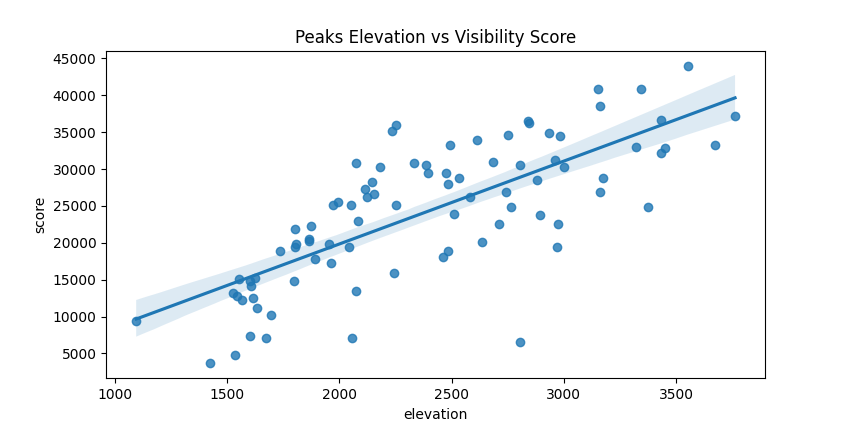
| name | elevation | score | |
|---|---|---|---|
| 153 | Cima Presanella | 3551.854004 | 43982.139194 |
| 90 | Punta Penia | 3342.749023 | 40791.724952 |
| 158 | Cima Brenta | 3152.949951 | 40791.724952 |
| 162 | Cima Tosa | 3162.955078 | 38512.857636 |
| 96 | Monte Cevedale | 3763.043945 | 37145.537247 |
| 165 | Anticima di Monte Fumo | 3433.218018 | 36689.763784 |
| 108 | Cimon del Latemar - Diamantiditurm | 2839.964111 | 36461.877052 |
| 155 | Cima d'Asta | 2843.674072 | 36233.990321 |
| 240 | Punta di mezzodì | 2253.288086 | 36006.103589 |
| 233 | Cima Palon | 2232.784912 | 35094.556663 |
In [22]:
Routes Visibility Analysis
In [23]:
routes = geo.compute_routes_score(dem, routes, peaks, crs, transform)In [24]:
routes.columnsIndex(['numero', 'competenza', 'denominaz', 'difficolta', 'loc_inizio',
'loc_fine', 'quota_iniz', 'quota_fine', 'quota_min', 'quota_max',
'lun_planim', 'lun_inclin', 't_andata', 't_ritorno', 'gr_mont',
'comuni_toc', 'geometry', 'row', 'col', 'panorama_score_weighted',
'panorama_score'],
dtype='object')In [25]:
In [25]:
| numero | denominaz | gr_mont | panorama_score_weighted | competenza | difficolta | loc_inizio | loc_fine | quota_iniz | quota_fine | quota_min | quota_max | lun_planim | lun_inclin | t_andata | t_ritorno | comuni_toc | panorama_score | |
|---|---|---|---|---|---|---|---|---|---|---|---|---|---|---|---|---|---|---|
| 483 | E646 | None | MARMOLADA / Colac' - Bufaure - L'Aut | 3.862061 | SEZ. SAT ALTA VAL DI FASSA | E | VAL DE CONTRIN | pr. FORCIA NEIGRA | 1771 | 2486 | 1771 | 2454 | 2030 | 2170 | 02:00 | 01:30 | CANAZEI-CIANACEI | 7.821029 |
| 95 | E207 | VIA FERRATA "GIUSEPPE HIPPOLITI" | CIMA DODICI - ORTIGARA | 3.447369 | SEZ. SAT BORGO VALSUGANA, SEZ. SAT LEVICO | EEA-F | SELLA - località Genzianella | ALTOPIANO | 902 | 1950 | 902 | 1970 | 6480 | 6780 | 03:15 | 02:20 | BORGO VALSUGANA, LEVICO TERME | 22.345980 |
| 297 | E157A | SENTIERO "ALBERTO GRESELE" | CARÉGA - PICCOLE DOLOMITI | 3.401106 | SEZ. SAT VALLARSA | E | MALGA STORTA | QUOTA 1601 | 1344 | 1601 | 1344 | 1601 | 1120 | 1170 | 00:55 | 00:30 | VALLARSA | 3.816173 |
| 192 | E207A | SENTIERO DELLA GROTTA DI COSTALTA | CIMA DODICI - ORTIGARA | 3.089812 | SEZ. SAT BORGO VALSUGANA | E | SPIGOLO DI COSTALTA | GROTTA DI COSTALTA | 1652 | 1688 | 1652 | 1702 | 220 | 240 | 00:10 | 00:05 | BORGO VALSUGANA | 0.689643 |
| 420 | E322C | None | LAGORAI / Costalta - Croce, LAGORAI / Mànghen ... | 2.997636 | SEZ. SAT BORGO VALSUGANA | E | MALGA VALSOLÈRO DI SOPRA | PASSO DEL MÀNGHEN | 1747 | 2043 | 1746 | 2045 | 1600 | 1640 | 00:50 | 00:40 | TELVE | 4.799935 |
In [26]:
rasterized = rio.features.rasterize(routes.geometry, out_shape=dem.shape,
                                    transform=transform, fill=0)
fig = plot.plot_routes_compare(dem, routes, rasterized)
fpath = os.path.join(conf.env.figures.path, "fig-routes-compare.html")
fig.write_html(fpath)
IFrame(src=fpath, width=conf.env.figures.width, height=conf.env.figures.width*0.6)In [27]:
size=50 and threshold=1000